


What Forms Of Spandex Are Used in Fabrics?
Jul 19, 2026
Leave a message
Spandex, when used in fabrics, generally comes in four forms: bare yarn, core-spun yarn, covered yarn, and twisted yarn.
Bare Yarn
Bare yarn is the earliest developed type of polyurethane elastic fiber. It has good tensile and recovery properties and can be used in production without spinning, thus offering the advantage of low cost. Due to its high coefficient of friction and poor slippage, bare yarn is rarely used directly in weaving; it is generally suitable for interweaving with other synthetic filaments on knitting machines. Major textile products include: compression garments, sportswear, leg warmers, surgical bandages, and sock cuffs and sleeves.
Core-Spun Yarn
This type of yarn uses polyurethane elastic fiber as the core yarn, wrapped with one or more non-elastic short fibers (cotton, wool, acrylic, polyester, etc.). The core layer provides excellent elasticity, while the outer fibers provide the desired surface characteristics. For example, cotton core-spun yarn, besides its good elasticity, retains the feel and appearance of ordinary cotton yarn. Its fabrics possess the style, feel, and performance of cotton cloth, and can be used to produce various cotton-type fabrics. Wool core-spun yarn clothing fabrics not only possess the appearance and good warmth of ordinary wool fabrics, but also have good resilience, allowing for free stretch and movement when worn, enhancing comfort and showcasing a beautiful figure. Core-spun yarn is the most widely used yarn variety among polyurethane elastic fibers.
Covered Yarn
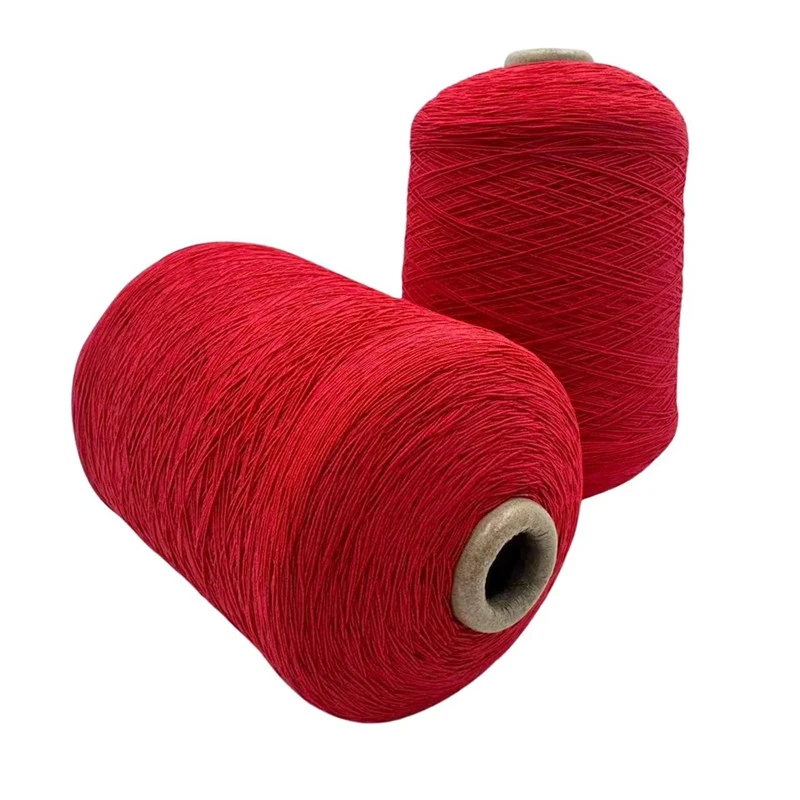
Covered yarn, also known as wrapped yarn, is an elastic yarn formed by spirally wrapping polyurethane elastic fibers around them. Covered yarn has a stiffer feel, coarser yarn, and produces thicker fabrics.
Covered yarn can be further divided into single-covered yarn and double-covered yarn. Single-covered yarn consists of a layer of filaments or yarn wrapped around the outer layer of polyurethane elastic fibers. Because of the fewer wrapping loops applied to the core yarn, core exposure sometimes occurs in high-elongation elastic fabrics. It is mainly used in elastic fabrics such as socks and weft-knitted underwear. Double-wrapped yarn consists of two layers of filaments or yarns wrapped around polyurethane elastic fibers, with the two layers wrapping in opposite directions. Since the outer fibers are symmetrically wrapped at opposite helical angles, the yarn achieves elasticity balance without further twisting. Double-wrapped yarn has higher processing costs and is mainly used in elastic fabrics such as leg warmers, elastic bands, sock cuffs, and pantyhose.
Twisted Yarn (also known as ply yarn) is made by simultaneously stretching polyurethane elastic fibers and twisting them together with two other inelastic yarns. Untwisting this yarn reduces tension and applies a slight impact to the entire yarn, allowing the relative movement between the yarns to stabilize. This results in the elastic fibers entering the core, while the other inelastic yarns become the outer wrapping layer, stabilizing the twisted yarn structure. This method can also be used to produce various fancy twisted yarns or three-in-one twisted yarns.
Twisted yarn is mostly used for weaving thick fabrics, such as elastic workwear and elastic single-sided gabardine. Its advantages include even yarn distribution and clean products. Disadvantages include a slightly stiffer hand feel, and some elastic fibers may be exposed, making color differences more likely during dyeing; therefore, it is generally not used for dark-colored fabrics.